
The Aroma Files #006: Coconut
The Aroma Files #006: Coconut
WIt’s not uncommon to pick up faint notes of coconut in our beer, more so in Belgian ales or Kveik fermented beer, and even more so in barrel aged selections. But without the intentional addition of coconut flavouring, where does it come from? Lets dive in. The coconut aroma can come from three sources. Esters, which are yeast derived, malt, specifically from the kilning, and oak barrels.
The specific compounds primarily responsible are lactones, which are cyclic esters. These form when a molecule has both a hydroxyl group ( -OH) and a carboxylic acid ( -COOH). Both these functional groups of course need to be on the same molecule, and basically the molecule snaps into a ring. Most of the lactones exhibiting coconut aromas are gamma lactones (𝛾-lactones), with five-carbons rings, or delta lactones (δ-lactones), with six-carbon rings. 𝛾-nonalactone provides a woody, creamy coconut aroma, 𝛾-octalactone a toasted coconut type aroma and δ-decalactone a sort of peachy tropical aroma. Cis-oak lactone produces an intense coconut expression, and is more common in American oak.
So let’s start with malt as it’s the least significant contributor. Toasted wheat or oats, some crystal malts, and toasted coconut aromatic malt all contain some lactones that can contribute a coconut flavour. Essentially, the toasting process oxidizes linoleic, oleic and palmitic acids, which then get cleaved and esterified and formed into lactones.
Yeast on the other hand has an array of pathways to coconut. On the ester side, Ethyl octanoate, commonly found in Belgian Ales, Saisons, and some Kveik strains has a detection threshold of 7mg/L and has a coconut and pineapple profile. Ethyl decanoate on the other hand is more common in big belgians and strong ales, it has a creamy tropical coconut note, and a threshold of 1.5mg/L. Both of these use either decanoic or octanoic acids plus ethanol as the substrates and are esterified by Eeb1P and Eht1P enzymes. But yeast have even more tricks up their sleeves. They can also produce lactones by metabolizing medium chain fatty acids like octanoic, nonanoic, decanoic, dodecanoic etc. These fatty acids undergo a beta oxidation whereby the fatty acid chain is shortened. Enzymes will then introduce hydroxyl groups to the chain allowing it to cyclize. When both the hydroxyl group and the carboxylic acid group are in the right places the molecule folds up into a ring. This happens during fermentation conditions when oxygen is limited and temperatures are on the warm side. Essentially, the yeast produces hydroxy fatty acids which then snap into a ring spontaneously.
So the first step is producing the hydroxy fatty acid. Cytochrome p450 monooxygenase, coded by CYP51,56,61 hydroxylate either fatty acids or sterol intermediaries. The next step is the conversion of the fatty acids into intermediates via beta oxidation. Acyl-CoA oxidase, enoyl-CoA hydratase/dehydrogenase and thiolase enzymes carry out this operation. The intermediates are then reduced to secondary alcohols via alcohol dehydrogenase and alcohol reductase enzymes. This introduces the second position hydroxyls. Finally thioesterases release the hydroxy-fatty acids from the CoA thioester and now it can cyclize.
The final and probably most important pathway to coconut is from the oak. The oak itself contains long chain fatty acids within cell walls along with the endogenous enzymes which will produce hydroxylated fatty acids. These are lipoxygenases which introduce hydroperoxy into long chain fatty acids becoming the precursors to cis and trans oak lactones. Hydroperoxide lyases then break these products down further into smaller oxygenated fatty acids. Epoxygenases then come along and add hydroxyl or epoxide groups to the fatty acids and this generates the structure for the gamma and delta lactones to form during toasting which is what converts the precursors into the lactones. These lactones being cis-oak and trans-oak lactones ( β-methyl-𝛾-octalactone). Cis-oak has the dominant coconut aroma, where the trans-oak lactone is more woody and herbal. This is because the cis isomer has a more compact shape and binds more easily to receptors. American oak has higher levels of the fatty acid precursors versus French oak and ergo more coconut. Toasting levels are important as well. The intensity increases with toasting up to the point where it gets too hot and cracks the fatty acids, reversing the trajectory and reducing the expression.
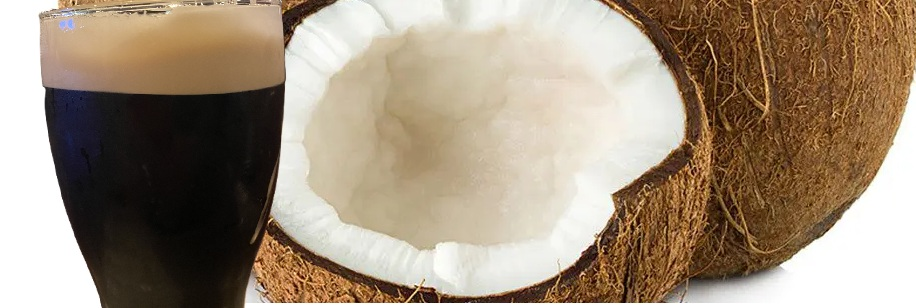
So what about coconut itself? Coconut flesh contains lauric, capric, and caprylic acids. When coconut flesh is toasted these fatty acids get partly oxidized and the intermediaries cyclize into 𝛾-octalactone, 𝛾-nonalactone, and δ-decalactone. It’s pretty much the same pathway as with the malt, but with way more inputs available.
And that’s coconut.
To further hone your aroma identification skills, Master Cicerone® Jen Blair’ ‘s Aroma: Explore The Wheel offers 100 common beer aromas! https://underthejenfluence.beer/
Six down, five-hundred to go!