
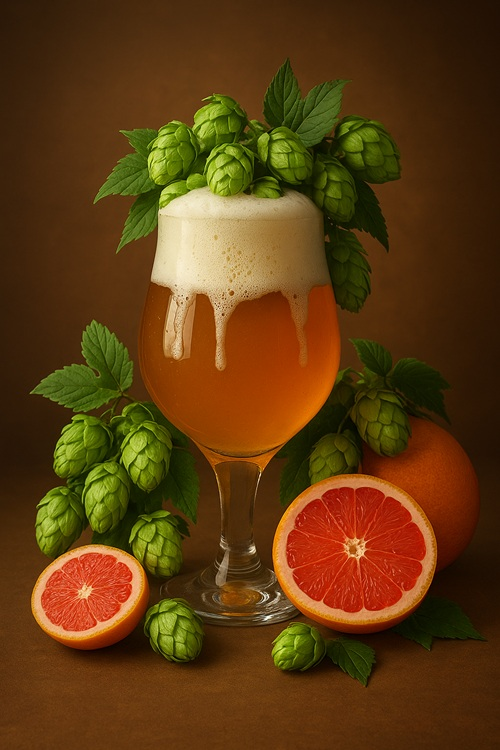
The Aroma Files #001: Grapefruit
Along with resin, pine, dank, and floral, grapefruit seems to be one of the most common basic descriptors of American hop aroma, heavily weighted towards IPAs. Of course we know (most of the time) there is no actual grapefruit in the beer, so where does this aroma and flavour come from? Is it truly grapefruit that we are smelling or are we led down that path? The second question is actually a bit more philosophical, but the first question is easy to answer.
First off let’s talk about the aromatic constituents of the grapefruit, component by component. The pith is the least important for aroma. It contains a bunch of flavonoids and limonoids that contribute to its bitterness, but the only real aroma compound is small amounts of limonene which migrates in from the peel where all the volatile hydrocarbons are housed. The flesh is secondary to the peel, but still contributes its share. We will focus on the flesh and peel.
The Flesh
The flesh is full of water soluble, fruity volatiles along with some sulfur based compounds. The defining aroma is a sesquiterpene ketone called nootkanone, which contributes the woody-grapefruit peel aroma. A few thiols, mainly the mouthful 1-p-menthene-8-thiol, contributes that grapefruit zest/catty aroma. It is found in small amounts, down in the parts per trillion range, but is super powerful. Limonene, a monoterpene, which is a common contributor of citrus aromas in general, has a low presence in the flesh. Limonene is something we will encounter over and over again in this series. A few other players serve to enhance the grapefruit aroma with their peripheral contributions. Ethyl Burtyrate, an ester generally associated with pineapple, brings a juiciness and sweetness while the terpene β-myrcene and the terpene alcohol linalool bring the ripe fruit quality to the bouquet.
The Peel
This is where it really comes to fruition. See what I did there? The peel is rich in oil glands which house the terpenes and aldehydes, both highly volatile aroma compounds. Limonene is the most abundant by far, making up 90-95% by weight and this contributes to the citrusy, orangy aroma. Nootkanone, as we discussed above, provides that classic grapefruit quality, and β-pinene and sabinene are two monoterpenes which provide a fresh and sharp resinous character. A nice fresh top note is contributed by the aldehydes decanal, octanal and nonanal. A couple of other aldehydes, called citral aldehydes, neral and geranial, occur in fairly small quantities and have a kind of sharp edged lemon aroma and can bring a sort of brightness to the party. Finally, 1-p-menthene-8-thiol, defines the true grapefruit zest character. It is also known as “Grapefruit Mercaptan”.
So this is all very interesting at the fruit counter, but what about the beer.
The Hops
As we will discuss ad nauseum, hops contain a plethora of volatile compounds including monoterpenes, oxygenated terpenes, aldehydes, and various sulfur compounds. There are many more, but those are the volatiles we are concerned with in this context.
Of the monoterpenes, Limonene, β-Myrcene, linalool and both β-pinene and α-pinene are shared amongst hops and grapefruit. Geraniol is present in hops, but in very small amounts in grapefruit. Citral aldehydes (neral and geranial), and the aldehydes decanal, octanal and nonanal are found across both hops and grapefruits whereas the oxygenated terpene citronellol is only found in hops and the sesquiterpene ketone nootkalone is found only in trace amounts in hops.
Of the sulfur compounds, 1-p-methene-8-thiol, which we will recall is also called grapefruit mercaptan shares a presence in both, while 3-mercaptohexanol and 3-mercaptoheyl acetate, both of which lend a kind of sweet grapefruit aroma, are found only in the hops.
But wait, there’s more?
Lets not forget the power of yeast to throw off an array of aromas during fermentation. Several yeast derived esters can contribute, albeit just slightly, to the overall grapefruit expression. Ethyl butyrate, is most closely associated with pineapple aroma, and is common in ale yeasts. Ethyl hexanoate and ethyl octanoate are esters that contribute a sweet citrus aroma, common in cleaner ale yeast strains and some wheatbeer specific yeasts.
β-demascenone, a metabolic byproduct of certain yeasts, can have a slight grapefruit character at low levels. β-demascenone is incidentally the major component in the aroma of roses.
Brettanomyces fermentation can result in the production of 4-mercapto-4-methylpentan-2-one ( 4MMP), 3-mercaptohexan-1-ol (3MH), and 3-mercaptohexyl acetate (3MHA) which can all contribute grapefruit notes, although the association can be loose, and 3MHA is more closely linked to passionfruit aromas. 4MMP is closely associated with New Zealand Sauvignon Blanc.
Malt can help out too, although non-directly, and much less significantly. The maillard reactions in kilning and roasting release some aldehydes and ketones which have some citrus character, including β-demascenone. As does lipid oxidation where trans-2-nonenal can help to sharpen fruit character when present in small amounts. Too much trans-2-nonenal however and the flavour of wet cardboard can move to the foreground.
So to wrap this all up, we have a slew of different grapefruit-like compounds in both the fruit itself and (mostly) hops in the beer, some unique to their host and some common across the two. The compounds we focus on the most are limonene, linalool, geraniol and 1-p-methene-8-thiol, keeping in mind that aroma and flavour are mental images constructed of multiple components and no one contributor is responsible for the entire picture.
To further hone your aroma identification skills, Master Cicerone® Jen Blair’ ‘s Aroma: Explore The Wheel offers 100 common beer aromas! https://underthejenfluence.beer/
That’s one down, 100 to go!