
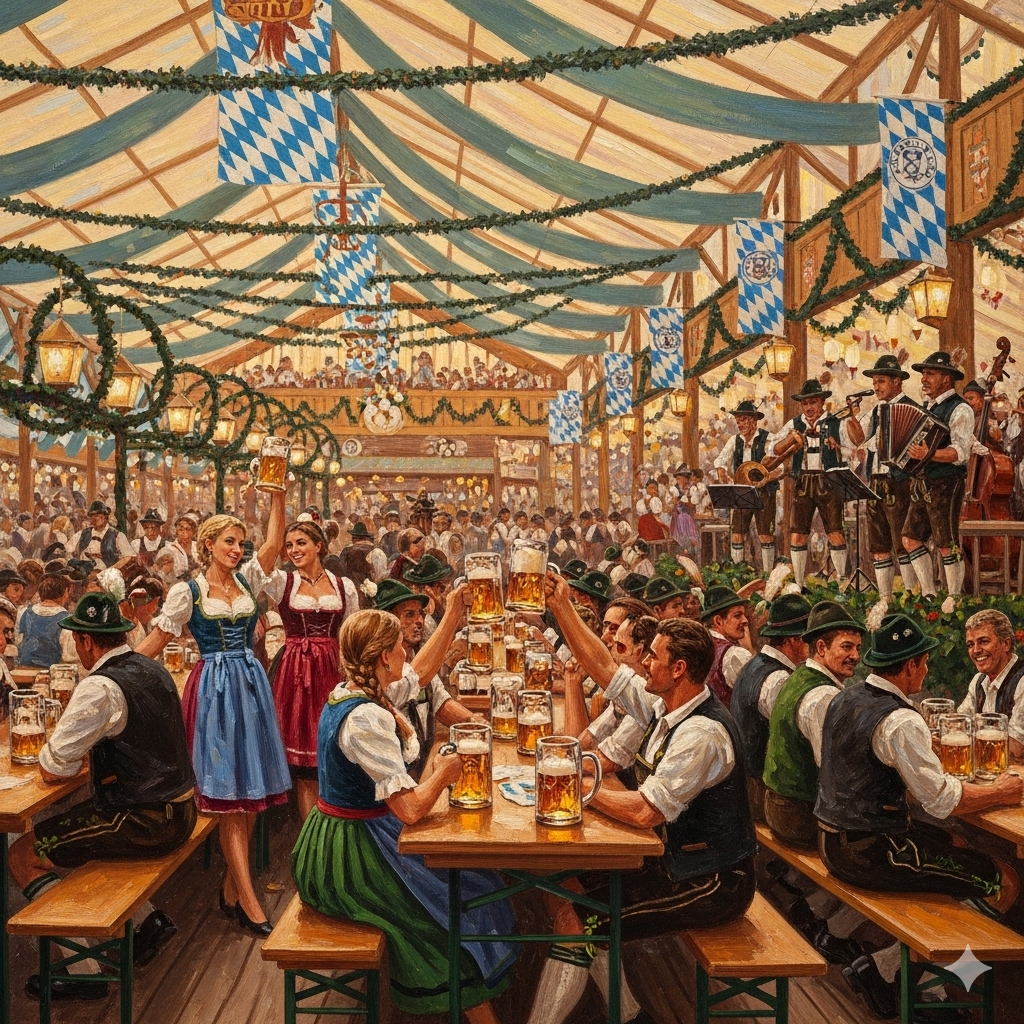
The Beers of Oktoberfest
As autumn settles in, the mornings turn crisp, the leaves shift to red and gold, and the sounds of clinking steins raised to “Ein Prosit der Gemütlichkeit” draw nearer. Oktoberfest is almost upon us- and with it comes the beer. But should you reach for a Festbier, an Oktoberfestbier, or a Märzen. What’s the difference? The answer is simply that it’s not that simple.
First let’s take a quick history of the festival and the beers. The whole affair began in 1810 when Crown Prince Ludwig of Bavaria married Princess Therese von Sachsen-Hildburghausen. Their wedding took place on Oct 12, and the entire city of Munich was invited to celebrate the event in the meadow just outside the city gates. The people liked the party so much that it became an annual tradition, eventually stretching out to the 16 day event that it is now.
Märzen means March. It’s pronounced “mare-tsen” FYI. Märzenbier was traditionally a beer brewed in March, and then stored in cool caves over the summer. The practice dates back to 1553 when Duke Albrecht V officially banned brewing between April 23-Sept 29. This beer was brewed stronger to last longer, and these original versions were fairly dark in colour.
In 1841, Spaten introduced a new lighter coloured “Märzenbier” using the recently developed munich malt. This beer was launched at Oktoberfest, but was not exclusive to the festival. Then in 1872, Spaten released a version that was specifically brewed for Oktoberfest and it became known as Oktoberfestbier. This beer is the basis of today’s Märzen. It is amber-orange in colour, with a clean malty aroma and flavour, along with some rich toast notes. The restrained bitterness can make it seem sweet upon the first sip but it will finish fairly dry. Märzen is a medium bodied beer with medium carbonation and a somewhat creamy mouthfeel.
In the 1970s, Paulaner started experimenting with paler and “less filling” versions. Of course the other brewers followed suit and by 1990 the paler beer had taken over Oktoberfest. This beer is now called Oktoberfestbier, or Festbier. It’s also sometimes called Wiesn (meadow) just to keep you on your toes. Festbier is a deep yellow or gold colour, has the same dominant malty richness as Märzen but with a bit less toast, and a slightly higher hop presence. It also tends to be less dry, but remains crisp. The carbonation is pretty similar, as is the body, but the mouthfeel is going to be a bit less full.
These descriptors carry through to modern day. So, if you are looking for something a bit more full, a bit more toasty and a bit less hoppy, Märzen is the choice. For something a little less full, a bit hoppier, and a bit less toasty, pick the Festbier.

Now, Oktoberfestbier is a PGI (protected Geographic indication) that means that only Augustiner, Hacker-Pschorr, Hofbräu, Löwenbräu, Paulaner, and Spaten can brew it, and it must be brewed within the Munich city limits. This also means that within the EU, an Oktoberfestbier is an Oktoberfestbier. A beer that fits the style but doesn’t meet the criteria is called a Festbier. Over here in North America, no such rules apply, and we thumb our noses at appellations, as evidenced by the cheese section of your local grocery store. Anyways, what this means to us is that outside of Europe, the names Oktoberfest, Märzen, and Festbier can be somewhat interchangeable. The only way to really know is to look, smell and taste, and then make a note for next time. If it smells like a Märzen, and looks like a Märzen, and tastes like a Märzen, it might be a Festbier. Just kidding, it’s probably a Märzen, but it may be labeled a Festbier, or a Märzen, or an Oktoberfestbier.
They are both delicious, and both appropriate for the season. So the next time you pour a pale Märzen, or an orange Festbier, just enjoy it, and smile, because you now know a secret.
Prost!