
The Worst (and Best) Glasses for Beer
Excluding paper cups, coffee mugs and plastic, the worst glass for beer is arguably the shaker pint. Unfortunately, many other beer glasses aren’t much better.
First of all, the shaker was never meant for beer. This is of course slightly less relevant because a lot of things were never intended for their current use. Occasionally, the novel use ends up being a better application anyways. But the shaker pint fails on many levels. When you stack them, which you shouldn’t do, the top glass forces outward pressure on the one below and so forth. They can become stuck and eventually chip or break. This is a problem for the barkeep and less so for the drinker, but they look bad and cheap, and this is a problem for everyone. No one wants a cheap looking wine glass, and no one should want a cheap looking beer glass either.
The major issue with the shaker pint is that the shape is neither conducive to aroma nor foam. Both of these are very important.
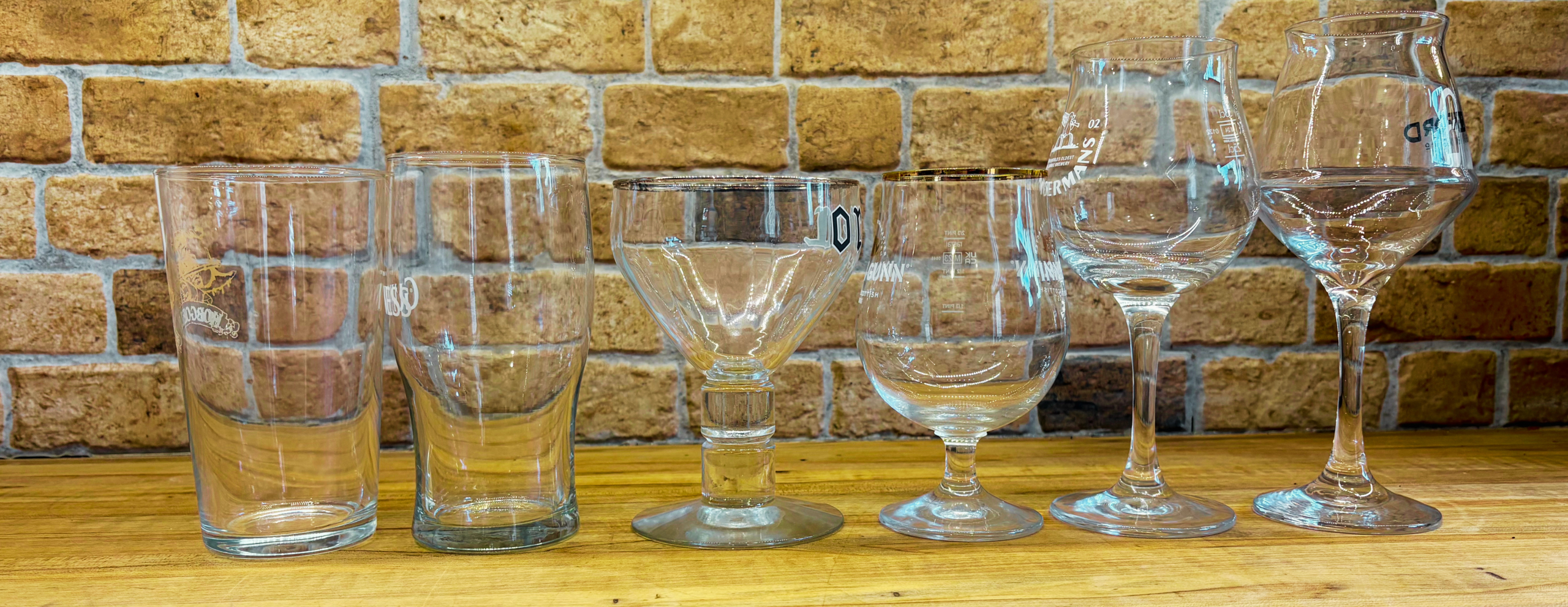
Slight upgrades to the shaker are the seidel, dimpled mug, nonic pint, tulip pint, Willi Becher etc. They all have a slightly improved shape and come steeped in tradition. Tradition is fine, but traditionally, we treated illnesses with leaches, and traditionally, a hot dog came with a glove instead of a bun. Traditional does not always mean better.
These glasses all have something in common, they are cylindrical. The weizen glass, and the pilsner glass, also cylindrical, are designed to support a nice cap of foam. Foam is important as I will continue to say, but it still doesn’t solve the major issue with shape.
Beer is a complex beverage, full of volatile aromatic compounds, and aroma is the basis for flavour. Simply eat something with your nose plugged and then unplug it if you are skeptical. These aromas need a place to gather, co-mingle, and remain somewhat captive. While the cylinder may allow for adequate volatilization, the aroma molecules simply exit the glass. A good analogy is this: There are twelve people in one room. The exit to the room is six people wide. In another room, the exit is two people wide. A fire starts at the make your own taco bar in each. Which room empties fastest? The volatiles in the glass are no different. Simply put, we want a glass that curves inwards at the top half to trap some aroma.
The Belgian tradition is to serve beer in its branded glass only, and not to serve that beer if said glass is unavailable. It’s a lovely thing to hold on to, but not if the glass is subpar. I love my collection of branded chalices, but that giant bowl is the equivalent of an open field. The ones with the inward curve at the top are much better, and exempt from malignment.
Unless you consume beer in a peculiar manner, you hold your beer glass in your hand. This transfers heat into the glass. This is fine if warming the beer is the goal, not so fine if it’s not. I will concede that the handle on the beer mug solves this issue, but it still doesn’t rectify the main problem.
The stem allows for temperate control. Need to warm it up, hold the bowl. Not so much? Hold the stem.
The best glasses are shaped somewhat like a wine glass. The Belgian stemmed Tulip is a fine glass, the snifter, and the goblet with an inward curve are all excellent. Even a wine glass works quite well. I am partial to the Teku glass because the lip angles outward after tapering in. This allows for both comfort, and ideal distribution. In other words, the beer flows into the mouth in a satisfactory manner. This is just a luxury add-on to the stem and curved bowl though. Those two are key. I also just like the shape.
I will concede that in certain unique circumstances, a proper glass is not practical. Guinness, and other nitro stouts would look funny outside the designated vessel, and some of the foamy Czech pours likely would not work as well. For all other beers, I stand firm.
Beer is a complex beverage and should be treated as such. Find a glass you like, with a stem that curves inward, fill it no more than halfway, and enjoy beer to the fullest.
Remember, you wouldn’t drink wine from a pint glass, so why drink beer from one?